Q5 — Question
Please tell me about the Vijayanagara Empire — how it became one of the richest empires in the world, what daily life in the capital looked like, what foreign travelers wrote about the city, why historians compare it to Rome or Constantinople, and why its destruction in 1565 is considered one of the greatest cultural catastrophes in Indian history.
Vijayanagara: The Great City of Bharat
The Rise, Wealth, and Destruction of One of the Greatest Cities in World History (1336–1565)
The Vijayanagara Empire (1336–1565) was one of the most powerful and prosperous empires in the World. Founded by Harihara I and Bukka Raya I, the empire built a magnificent capital city at Vijayanagara (modern Hampi in Karnataka). At its height, this city was among the largest and richest urban centers in the world, admired by travelers from Persia, Europe, and other regions. Its wealth, cultural achievements, and monumental architecture made it comparable to the great cities of world history.
How Vijayanagara Became One of the Richest Empires in the World
Trade Networks
Vijayanagara controlled major trade routes across South India and the Indian Ocean. Merchants traded with Arabia, Persia, Southeast Asia, and Europe. Exports included spices, textiles, rice, and precious stones.
Agricultural Prosperity
The empire invested heavily in irrigation systems including canals, reservoirs, and tanks. These advanced water systems made the region extremely productive agriculturally.
Diamond and Horse Trade
Nearby diamond mines produced gems that dominated global markets. The empire also imported valuable horses from Arabia and Persia for its powerful cavalry.
Stable Governance
Strong administration protected merchants, regulated taxation, and maintained stable provincial governance, encouraging commerce and prosperity.
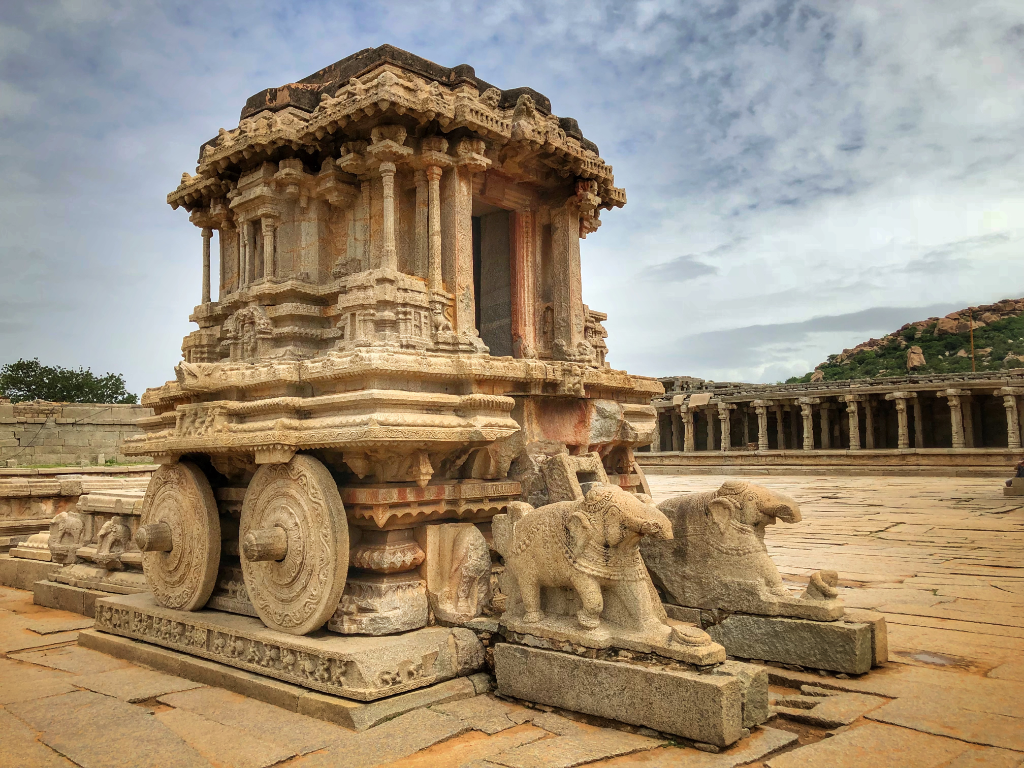
Daily Life in the Capital
The capital city of Vijayanagara was a bustling metropolis filled with markets, temples, scholars, merchants, and soldiers. Temple avenues were lined with bazaars selling silk, spices, jewelry, horses, elephants, and food grains. The city supported vibrant cultural traditions including music, dance, literature, and temple festivals. Languages such as Sanskrit, Telugu, Kannada, and Tamil flourished under royal patronage.
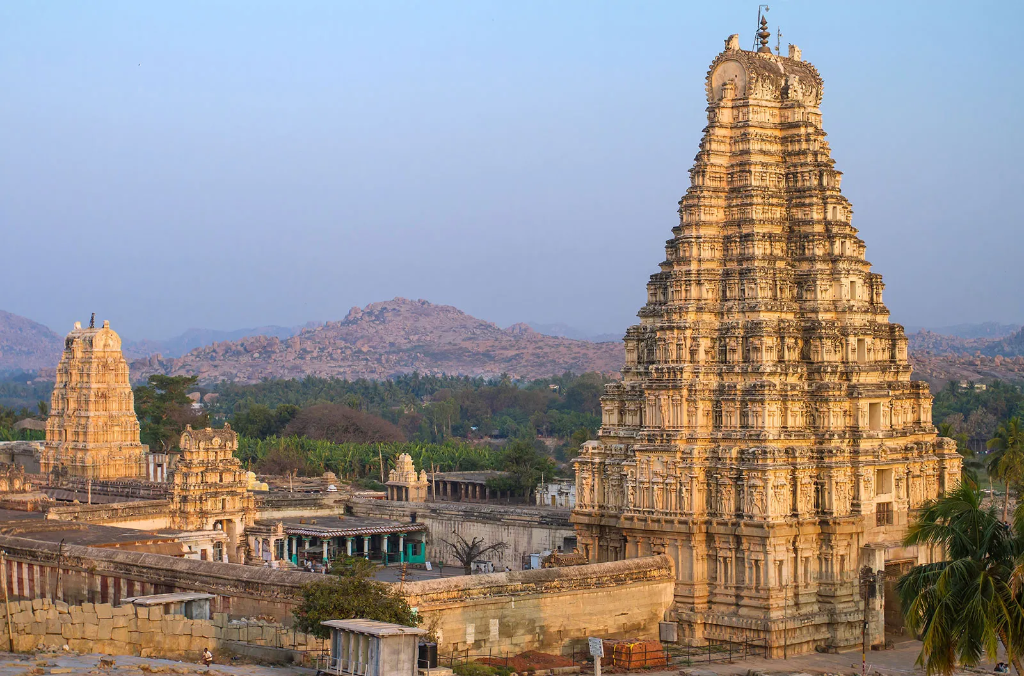
Virupaksha Temple, Hampi
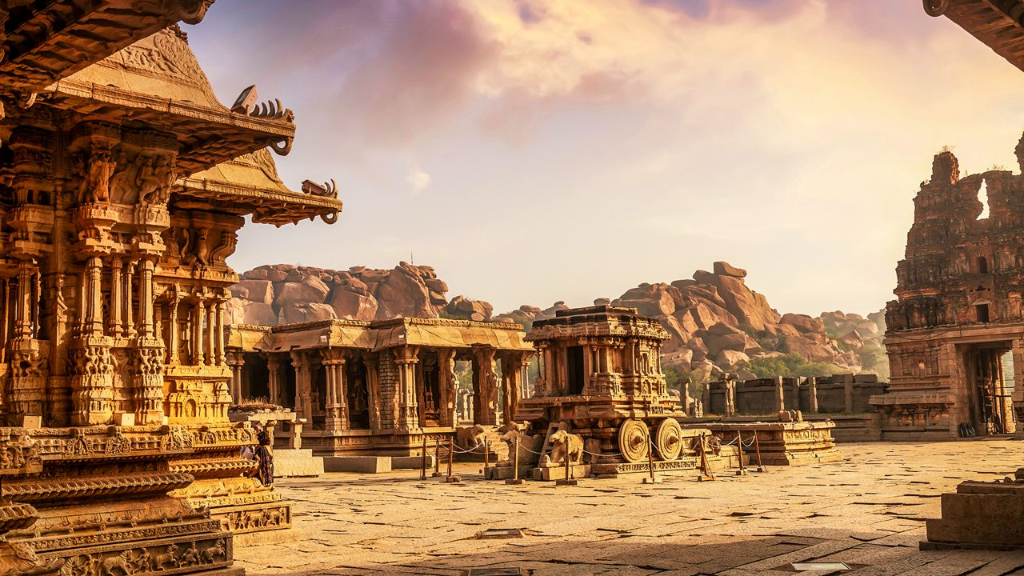
Vittala Temple Complex
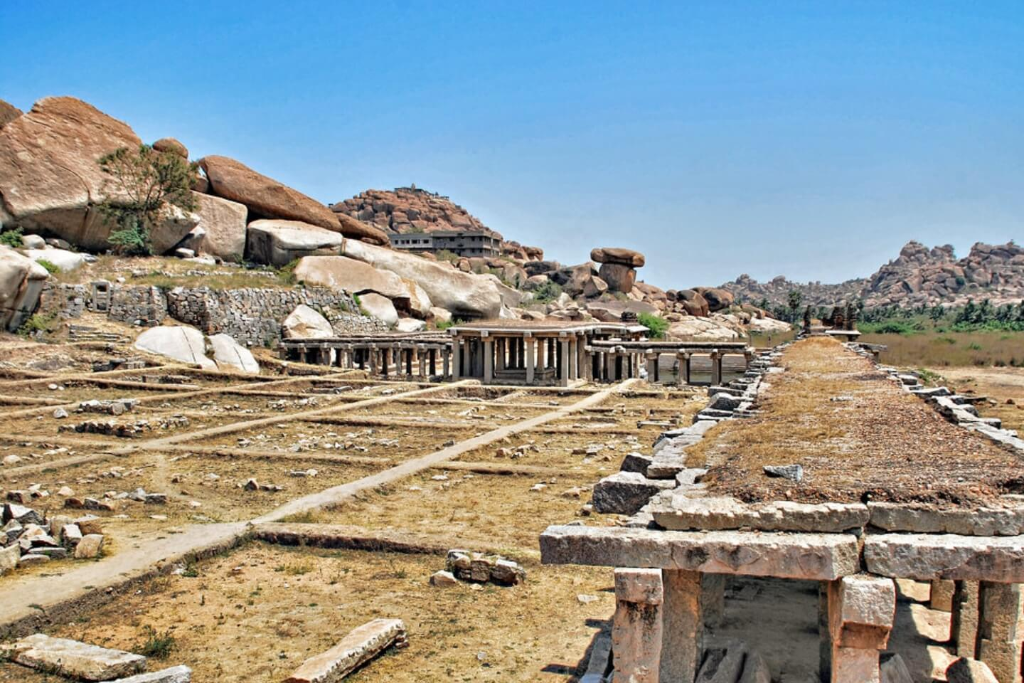
Ancient Bazaar Ruins, Hampi
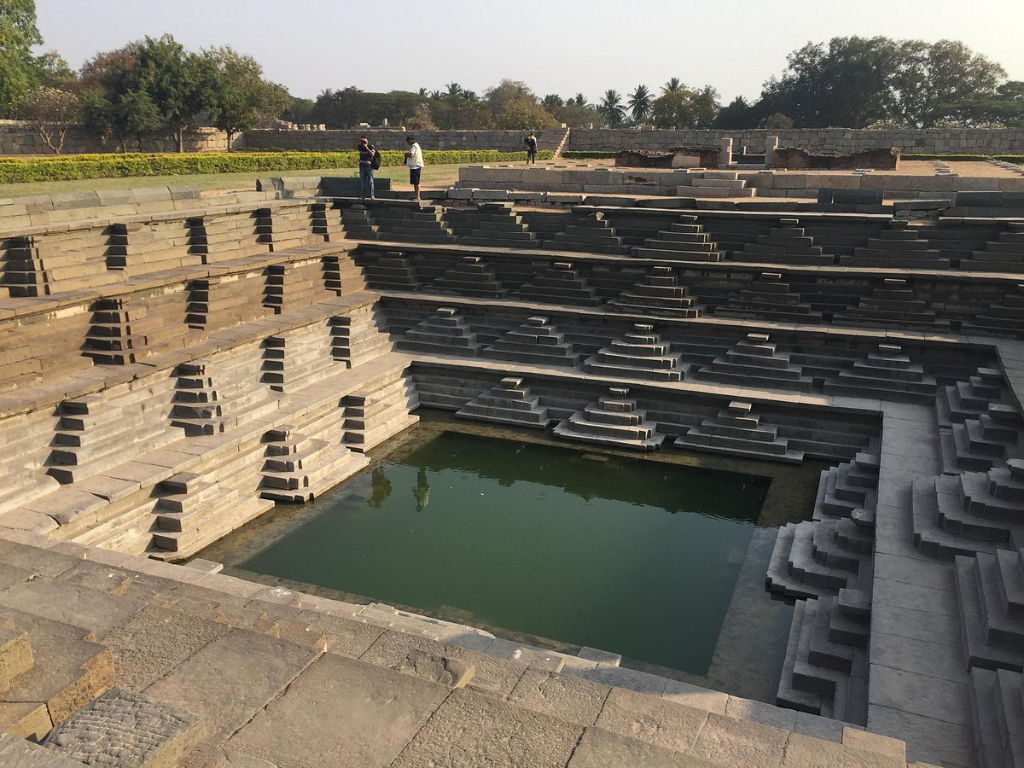
Royal Stepped Tank
Monuments of Vijayanagara still stand today at Hampi, a UNESCO World Heritage Site.
What Foreign Travelers Wrote About the City
"The pupil of the eye has never seen a place like it."
He described vast markets, immense wealth, and a flourishing population.
Abdur Razzaq
Persian diplomat, 1440s
"An enormous city filled with temples and thriving commerce."
One of the earliest European visitors to describe the city's grandeur.
Niccolò de' Conti
Italian traveler
"Grand royal processions, powerful armies, and extraordinary wealth."
He recorded the city's military might and royal splendour in vivid detail.
Domingo Paes
Portuguese traveler
"One of the largest cities in the world."
He described the capital surrounded by strong fortifications and prosperous villages.
Fernão Nunes
Portuguese chronicler
Why Historians Compare Vijayanagara to Rome or Constantinople
Reasons for Comparison
- Immense population
- Monumental architecture
- Powerful military
- Vast economic influence
Like Rome or Constantinople, It Was…
- A major cultural center
- A political capital
- A hub of international trade
Timeline of the Empire
1336
Empire founded by Harihara I and Bukka Raya I
1400s
Rapid economic expansion
1509–1529
Golden Age under Krishnadevaraya
1520s
Portuguese travelers describe the city's wealth
1565
Battle of Talikota & destruction of capital
The Catastrophic Destruction of Vijayanagara (1565)
In 1565 the Vijayanagara army was defeated at the Battle of Talikota by a coalition of Deccan Sultanates. Following the battle, the victorious forces entered the capital city and looted and destroyed large parts of it. Temples, palaces, and markets were damaged or abandoned. The once magnificent city was gradually deserted.
Why the Fall of Vijayanagara Was a Cultural Catastrophe
- Destruction of a major center of Indian culture
- Damage to temples and institutions
- Collapse of a powerful empire
- Abandonment of one of the largest cities in the world
Today the ruins of Hampi remain a powerful reminder of this lost civilization.
Legacy of Vijayanagara
Despite its tragic destruction, Vijayanagara remains one of the most remarkable civilizations in Indian history. Its achievements in architecture, commerce, governance, and culture made it one of the greatest cities of the medieval world. The surviving monuments at Hampi continue to testify to the extraordinary legacy of the Vijayanagara Empire.
The Vijayanagara Empire
India's Last Great Hindu Capital (1336–1565)
Founded in 1336, Vijayanagara rose as a civilizational powerhouse — a fortified capital, a global trading hub, and a cultural beacon that preserved Hindu knowledge systems for over two centuries.
How Vijayanagara Became One of the Richest Empires
- Massive irrigation networks
- Fertile river valleys
- Diamond mines of Golconda
- Control of horse trade
- Thriving ports on both coasts
What This Created
- A surplus economy
- Global merchant traffic
- A powerful military
- A treasury famed across continents
A Mega‑City
Population of 300,000–500,000, larger than London or Paris at the time.
Bustling Bazaars
Streets filled with silk, spices, jewels, horses, and fine metalwork.
Temples & Festivals
Daily rituals, music, dance, and vibrant cultural life.
"Vijayanagara is as large as Rome."
Niccolò de' Conti
Italy, 1420s
"The eye has never seen a place like it."
Abdur Razzaq
Persia, 1440s
"The king's jewels are beyond imagination."
Domingo Paes
Portugal, 1520s
A Civilizational Shield
For over 200 years, Vijayanagara protected South India from repeated invasions, preserved temple networks, supported Sanskrit and regional literatures, and maintained the continuity of Hindu cultural life.
In 1565, after the Battle of Talikota, the capital was burned for months. Temples, palaces, libraries, and markets were destroyed. The city was abandoned and never rebuilt.
Historians consider this one of the greatest cultural losses in Indian history.
1336
Empire founded
1420s
Italian accounts
1440s
Persian envoy's visit
1509–1529
Krishnadevaraya's Golden Age
1520s–1530s
Portuguese descriptions
1550s
Peak urban scale
1565
Destruction of the capital
The Vijayanagara Empire — An Overview
The Vijayanagara Empire (1336–1565 CE) was one of the most powerful and culturally vibrant empires in Indian history, ruling much of South India for over two centuries. Founded by the brothers Harihara I and Bukka Raya in 1336 CE on the banks of the Tungabhadra River, it rose as a bulwark against the southward expansion of the Delhi Sultanate.
At its zenith under Krishnadevaraya (r. 1509–1529 CE) — widely regarded as its greatest ruler — Vijayanagara controlled an empire stretching from the Krishna River in the north to the tip of the Indian subcontinent, encompassing modern Karnataka, Andhra Pradesh, Tamil Nadu, Kerala, and parts of Goa. It was a cosmopolitan, multi-religious empire that actively patronized Hindu, Jain, and even Islamic scholarship and trade.
How Vijayanagara Became One of the Richest Empires in the World
Vijayanagara's extraordinary wealth flowed from several interlocking sources:
Control of the Diamond Trade:
The empire sat atop the Golconda diamond fields — the only known source of diamonds in the world before the 18th century discovery of Brazilian deposits. Diamonds, rubies, and emeralds were traded in the city's markets like grain. Foreign visitors described diamonds being sold by weight in open bazaars.
Spice Trade Dominance:
Vijayanagara controlled the pepper, cardamom, and textile trade routes connecting India's interior to the Arabian Sea ports of Goa, Calicut, and Mangalore. Portuguese, Arab, Persian, and Chinese merchants all traded through its ports. Pepper alone made fortunes that European powers would later wage wars over.
Agricultural Engineering:
The empire invested massively in irrigation — building hundreds of tanks, reservoirs, and canals in the Deccan plateau. This transformed semi-arid land into productive farmland and ensured food security and agricultural surplus.
Textile Manufacturing:
Vijayanagara was a major producer and exporter of fine cotton and silk textiles. Its weavers supplied markets from Persia to Southeast Asia.
Port Revenue & Customs:
The empire taxed a rich network of Indian Ocean trade. Customs revenue from ports like Goa contributed enormously to the treasury.
Military Strength = Trade Security:
By maintaining powerful armies — including war elephants, cavalry, and artillery — Vijayanagara kept trade routes safe and merchants confident, drawing commerce from across the known world to its capital.
Daily Life in the Capital — A City of Wonders
The capital city — also called Vijayanagara (modern Hampi, Karnataka) — was a breathtaking metropolis. At its peak it housed an estimated 500,000 people, making it one of the five largest cities in the world, comparable to contemporary London, Cairo, and Beijing.
The Royal Quarter:
The city's core contained magnificent palaces, royal baths, elephant stables, audience halls, and temples. The Lotus Mahal, the stepped tanks, and the Hazara Rama temple complex reflected a sophisticated aesthetic of carved stone, open courtyards, and water channels that kept the city cool.
The Sacred Heart:
The Virupaksha temple — dedicated to Lord Shiva — was the spiritual center, continuously worshipped since before the empire and still active today. It was surrounded by a bustling temple town.
Markets & Commerce:
The city was divided into specialized bazaars — streets of jewelers, cloth merchants, perfumers, horse traders, and food vendors. The "King's Market" (described in detail by foreign travelers) was flanked by colonnaded halls filled with merchants from across Asia and the Middle East.
Festivals:
The city came spectacularly alive during Mahanavami (Navaratri), the nine-day royal festival during which the king received tribute, presided over military reviews, animal fights, and dances, and distributed lavish gifts. Foreign visitors who witnessed it described it as unlike anything in the world.
Social Life:
Vijayanagara was relatively cosmopolitan. Persian-speaking Muslim merchants had their own quarter. There were taverns, gardens, and pleasure parks. Devadasi dancers attached to temples performed daily rituals and public concerts. The city had a developed legal and administrative system with guilds managing trade and crafts.
What Foreign Travelers Wrote — Extraordinary Accounts
Some of the most vivid descriptions of Vijayanagara come from foreign travelers who visited and were astonished by what they saw:
Domingo Paes (Portuguese, c. 1520):
"The city is as large as Rome and very beautiful to the sight... it is the best-provided city in the world... it is a place of great commerce and great abundance of all things... The bazaars are very large and have everything you want." He described markets where rubies, diamonds, and pearls were sold openly, the streets were always crowded, and the king's palace outshone anything in Europe or Asia.
Fernão Nunes (Portuguese, c. 1535):
Described the capital as having "streets wider than any in Lisbon," and the royal palace as containing halls whose ceilings were made of ivory. He marveled at the elephant stables, the organized military, and the sheer scale of the city's architecture.
Abdur Razzaq (Persian ambassador from Samarkand, 1443):
"The pupil of the eye has never seen a place like it, and the ear of intelligence has never been informed that there existed anything to equal it in the world. The city of Vijayanagara is such that the pupil of the eye has never seen its like... the bazaars are extremely long and broad." He described the streets paved in colored stones, the merchants selling silks and precious gems, and a city of extraordinary beauty and organization.
Niccolò de' Conti (Venetian traveler, c. 1420):
One of the earliest European visitors, he described a powerful, well-organized kingdom with a sophisticated court and an army of over a million soldiers.
These accounts, independent of each other and spanning over a century, consistently describe the same extraordinary city — vast, wealthy, beautiful, and cosmopolitan.
Why Historians Compare Vijayanagara to Rome and Constantinople
The comparison to Rome and Constantinople is not poetic exaggeration — it is historical and structural:
Scale & Population:
At 500,000+ inhabitants, Vijayanagara was comparable to Rome at its height and Byzantine Constantinople. It was one of the largest cities on Earth in the 15th–16th centuries, when most European cities had fewer than 50,000 people.
Imperial Grandeur:
Like Rome, Vijayanagara was the center of a far-flung empire, receiving tribute from kings, hosting ambassadors from distant lands, and projecting power through monumental architecture.
Cultural Synthesis:
Like Constantinople, it was a crossroads of civilizations — Hindu, Jain, Muslim, and Christian merchants, scholars, and diplomats coexisted. It was neither parochial nor insular.
Architectural Magnificence:
The capital's 25+ square kilometers of ruins (the largest such ruins in India) contained temples, palaces, aqueducts, granaries, and market halls built with engineering sophistication. The sheer density and scale of stone construction parallels Roman urban planning.
Center of a Civilization:
Most importantly, Vijayanagara was the last great Hindu empire to shield South Indian culture, temples, Sanskrit learning, Carnatic music, Bharatanatyam dance, and temple architecture from the political disruptions transforming North India. It was, in a real sense, the Rome of South India — a civilization-defining city.
The Destruction of 1565 — One of History's Greatest Cultural Catastrophes
The fall of Vijayanagara is one of the most devastating and least-known catastrophes in world history.
The Battle of Talikota (January 23, 1565):
A coalition of five Deccan Sultanates — Bijapur, Ahmadnagar, Golconda, Bidar, and Berar — united against Vijayanagara. In the Battle of Talikota, the Vijayanagara army was routed, and its commander Aliya Rama Raya was captured and beheaded on the battlefield. The army collapsed.
The Sack of the City:
What followed was not merely a military occupation — it was deliberate annihilation. For six months, the five sultans' armies systematically looted, burned, and destroyed the city. Contemporary accounts describe: - Temples pulled down and idols smashed - Libraries and manuscripts burned - Palaces, markets, and homes demolished - The population massacred or enslaved - The city's irrigation infrastructure deliberately destroyed, turning surrounding farmland to desert
Historian Robert Sewell, in his landmark 1900 work A Forgotten Empire, wrote: "The city was thoroughly sacked... Never perhaps in the history of the world has such havoc been wrought, and wrought so suddenly, on so splendid a city, teeming with a wealthy and industrious population in the full plenitude of prosperity."
Why It Was a Cultural Catastrophe:
• **Irreplaceable manuscripts** on medicine, mathematics, music, astronomy, and philosophy were destroyed — knowledge accumulated over centuries, gone in weeks. • **Temple traditions** maintained for centuries were severed — priests fled, rituals stopped, sacred art was smashed. • **Artistic lineages** of sculpture, bronze-casting, music, and dance were disrupted — many traditions never fully recovered. • **South Indian political unity** collapsed — the region fragmented into smaller kingdoms, many of which soon fell to European colonizers. • **The economic network** — the trade routes, port cities, and craft guilds — collapsed, impoverishing a region that had been among the wealthiest in the world.
The City Was Never Rebuilt:
Unlike Rome, which was sacked but rebuilt, Vijayanagara was abandoned entirely. Its ruins were slowly swallowed by jungle. For centuries, the outside world largely forgot it existed. It was only in the 19th century that historians began piecing together its story from ruins and the accounts of foreign travelers.
Today, Hampi is a UNESCO World Heritage Site — a haunting, beautiful field of ruins that still conveys the ghost of a city that was once Rome's equal in the East.
The Legacy:
The destruction of Vijayanagara removed the last great political and cultural protector of classical South Indian civilization. It accelerated the decline of Sanskrit scholarship, classical arts, and indigenous scientific traditions. Many historians argue that India never fully recovered from this loss before it encountered European colonialism — making 1565 a hinge point in the long arc of Indian history.
Vijayanagara was not just a kingdom — it was a civilizational statement.
Its ruins at Hampi still echo the confidence, creativity, and resilience of Indian civilization.
"The city is as large as Rome and very beautiful to the sight... it is the best-provided city in the world."
— Domingo Paes, Portuguese traveler, c. 1520 CE

