IKS Perspective · Q&A #6 · Page 32
Surplus Economy, Maritime Trade & How Europe Learned to Sail the Oceans
Indian Knowledge Systems — Civilizational Perspective
How Europe Learned to Sail the Oceans
An Indian Ocean & IKS Perspective on the Real "Age of Discovery"
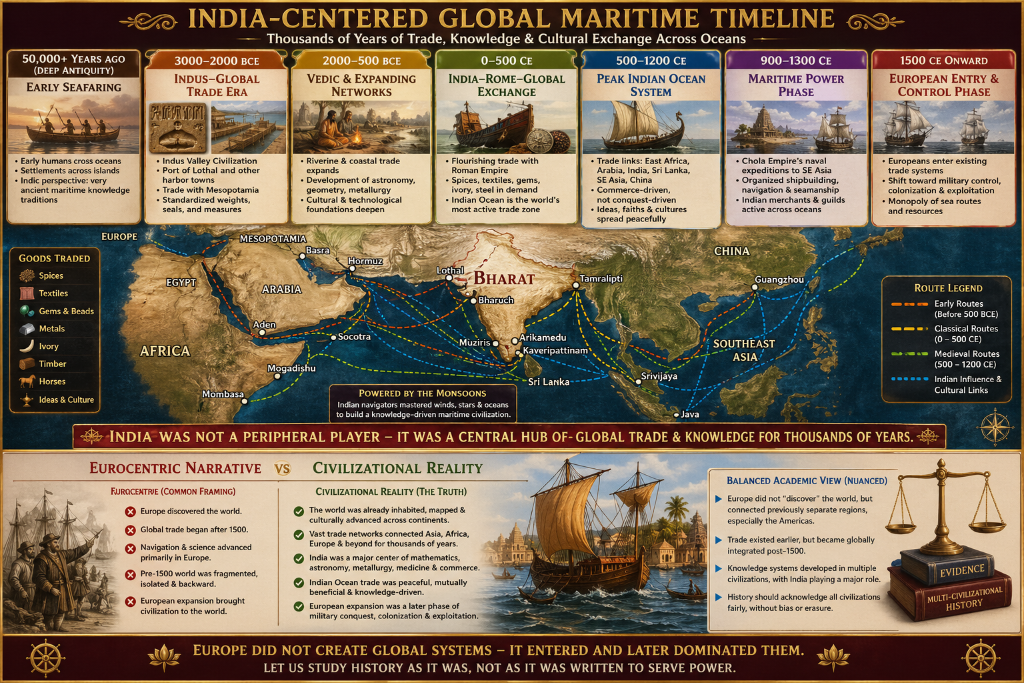
For most of history, Europe could not sail far from land. India, Arabia, and East Africa had mastered monsoon navigation for 3,000+ years. Europe's oceanic revolution was not an invention — it was an inheritance.
Foundation
Three Pillars of Indian Knowledge Systems
1. Geography & Ecology
Natural abundance and environmental diversity. Fertile river plains, diverse ecosystems, and a stable climate enabled continuous, surplus-generating agriculture for millennia.
2. Surplus Economy & Maritime Trade
Long-distance trade, wealth generation, and civilizational connectivity. Indian merchants sailed the Indian Ocean world for 3,000+ years, generating the surplus that funded learning.
3. Integrated Knowledge Systems
Mathematics, astronomy, medicine, metallurgy, language, philosophy, governance, and arts reinforcing one another — creating a self-sustaining civilization of knowledge.
🌏 India → Arabs → East Africa → Europe → "Age of Discovery"
The Missing Foundation
Surplus Economy & Maritime Trade
Knowledge Requires Surplus
Great knowledge systems do not emerge from societies struggling merely to survive. They emerge where there is:
- •Agricultural surplus
- •Economic stability
- •Trade networks
- •Urban centers
- •Patronage of learning
- •Long-term continuity
For thousands of years, Bharat possessed all of these simultaneously.
The Indian Ocean Was Bharat's Highway
Long before the modern age, Indian ports connected Bharat with:
- ›Southeast Asia
- ›Arabia
- ›East Africa
- ›Sri Lanka
- ›Central Asia
- ›Mediterranean trading networks
Trade carried goods, wealth, ideas, technologies, and cultural influence.
Wealth Creates Time for Learning
Economic surplus creates something precious: Time. When societies generate surplus wealth, people can specialize. Some become:
- Mathematicians
- Astronomers
- Physicians
- Metallurgists
- Philosophers
- Linguists
- Architects
- Teachers
Merchants Were Also Carriers of Ideas
Indian traders carried more than goods. They carried:
- ›Languages & scripts
- ›Stories & cultural practices
- ›Mathematics & sciences
- ›Religious ideas
- ›Technologies & artistic traditions
Trade routes became knowledge routes.
Ports Were Knowledge Hubs
Ancient ports were not merely commercial centers. They were meeting points of civilizations. Ideas moved alongside cargo:
- ›New techniques & measurements
- ›Navigational methods
- ›Medicines & plants
- ›Artistic traditions
- ›Scientific observations
Why Indian Knowledge Became Integrated
Mathematics supported astronomy.
Astronomy supported calendars.
Calendars supported agriculture.
Agriculture supported surplus.
Surplus supported universities.
Universities trained scholars.
Scholars advanced medicine, language, philosophy, engineering, and governance.
The system reinforced itself.
The Civilizational Formula
Key Insight
The rise of Indian knowledge systems cannot be explained only through philosophy, spirituality, or individual genius. A deeper foundation existed:
A prosperous, connected, trade-supported civilization that generated surplus wealth for centuries.
That surplus supported teachers, scholars, universities, craftsmen, navigators, guilds, scientific inquiry, and the preservation of knowledge across generations.
Without surplus, knowledge struggles to survive.
With surplus, knowledge becomes civilization.
Indian Knowledge Systems — Student Version
How Europe Learned to Sail the Oceans
For most of history, Europe could not sail far from land. This is why Europeans reached India only 600 years ago.
The Big Idea
India and the Indian Ocean world were the teachers.
Europe was the last student.
Europe's "Age of Discovery" was actually an Age of Learning — built on thousands of years of Indian, Arab, and African maritime knowledge.
Advanced Version — For Adults
The Knowledge Chain
India → Arabia → Africa → Europe
3000 BCE – 1500 CE
India: The First Ocean Civilization
- ›Monsoon science & seasonal navigation
- ›Star navigation (Nakṣatra system)
- ›Trigonometry — jyā → sine/cosine
- ›Teak deep-sea shipbuilding
- ›Ports: Lothal, Dholavira, Muziris
- ›Routes to Africa, Arabia, Southeast Asia
800 – 1500 CE
Arabs: The Knowledge Bridge
- ›Astrolabe navigation (from Indian models)
- ›Wind & ocean current charts
- ›Star-compass systems
- ›Translated Indian astronomy & math into Arabic, then Latin
1000 – 1500 CE
East Africa: The Practical Teachers
- ›Large sewn-plank ocean dhows
- ›Expert monsoon crossings
- ›Indian–Arab–African trade hubs
- ›The Malindi pilot who guided Vasco da Gama to India
1400 – 1500 CE
Europe: The Last Student
- ›Borrowed trigonometry from Indian via Arab sources
- ›Borrowed astrolabe navigation
- ›Copied lateen sails from Arab dhows
- ›Learned wind-gyre Atlantic routes
- ›Reached India only in 1498 CE
← Scroll to explore →
Scholarly Evidence
What Europe Learned — And From Whom
From India
Trigonometry & Navigation
- ›Indian jyā & koṭi-jyā tables → sine/cosine
- ›Essential for latitude sailing
- ›Adopted by Arabs → transmitted to Europe via Latin translations
From India & Arabs
Star-Based Navigation
- ›Indian Nakṣatra navigation system
- ›Arab astrolabe refinements
- ›Europe adopted both systems after 1300 CE
From Indian Ocean World
Monsoon & Wind-Gyre Knowledge
- ›Indian Ocean monsoon cycle science
- ›Swahili & Arab seasonal sailing patterns
- ›Europe learned only after 1400 CE
From Arabs & India
The Hybrid European Ship
- ›Lateen sails — from Arab dhows
- ›Hull reinforcement — Indian Ocean tradition
- ›Sternpost rudder — Chinese origin
- ›The caravel = assembled borrowed technologies
From East Africa & India
The Malindi Pilot
- ›Guided Vasco da Gama across the Arabian Sea
- ›Europeans lacked monsoon knowledge
- ›Indian Ocean pilots were essential intermediaries
Historical Record
Evidence from Texts & Archaeology
- ›Periplus of the Erythraean Sea (1st CE)
- ›Arab navigational manuals (Ibn Majid)
- ›Indian port archaeology at Lothal & Muziris
- ›Portuguese chronicles acknowledging Indian Ocean pilots

