Q5-R2 · Indian Knowledge Systems · BharatHeritage.com
Indian Knowledge Systems
A Civilization Built Around Integrated Knowledge
IKS were not isolated discoveries — they formed an interconnected civilizational framework linking language, science, ethics, philosophy, mathematics, health, and consciousness into a unified vision of knowledge.
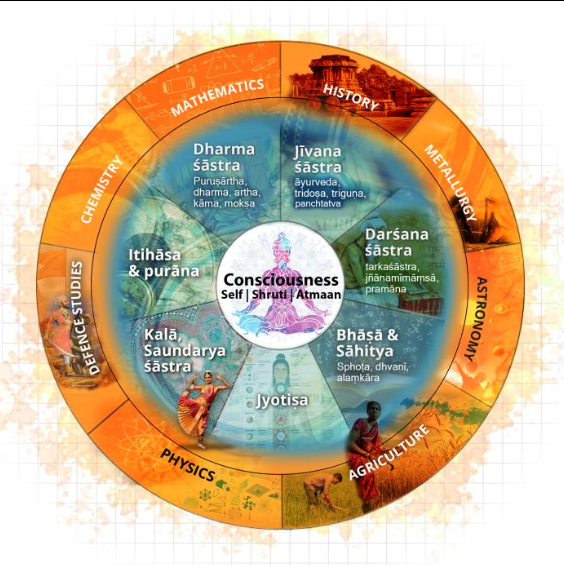
Source: Indian Knowledge Systems (IKS) — ChatGPT Research Summary · Q5-R2
Introduction
What Is IKS?
The phrase Indian Knowledge Systems (IKS) refers to the vast intellectual traditions developed in the Indian civilization across thousands of years. These systems were not isolated discoveries.
They formed an interconnected civilizational framework involving:
What makes IKS remarkable is not only the breadth of subjects, but the way they were integrated into a coherent worldview — knowledge was seen as interconnected.
Section 1
What Were Indian Knowledge Systems?
Indian civilization developed organized traditions of inquiry across many domains. These traditions evolved through:
Knowledge was preserved through:
Section 2
The Foundational Civilizational Idea
At the center of many Indian traditions was the belief that reality possesses order, structure, and interconnection. This appears in concepts such as:
Ṛta
Cosmic Order
Dharma
Ethical Order
Karma
Cause & Consequence
Yoga
Integration
Vidyā
Knowledge
Knowledge therefore was not merely technical. It was connected to ethics, society, nature, consciousness, and human responsibility.
Section 3
Major Domains of Indian Knowledge Systems
India developed advanced, organized traditions across a remarkable range of disciplines:
Language & Linguistics
Pāṇini's ~4,000-rule grammar system; phonetics, sound classification, and the roots of formal linguistics & computer science.
Mathematics
Decimal place-value system, zero, algebra, trigonometry. Scholars: Aryabhata, Brahmagupta, Bhāskara II.
Astronomy
Planetary motion, eclipses, lunar cycles, time measurement — deeply integrated with mathematics.
Medicine & Health
Ayurveda's holistic framework of body, mind & environment. Charaka & Sushruta on surgery, pharmacology, nutrition.
Logic & Philosophy
Nyāya, Vedānta, Sāṅkhya, Mīmāṁsā, Buddhist logic — epistemology, metaphysics, and the nature of consciousness.
Ecology & Sustainability
Sacred ecology, interdependence, reverence for rivers & forests — a cyclical, non-extractive model of nature.
Yoga & Consciousness
Patañjali's systematic exploration of mind, meditation, attention, and self-awareness — not merely exercise.
Governance & Arts
Statecraft (Arthaśāstra), architecture, music theory, dance — organized as formal śāstras across centuries.
Section 4
Universities and Knowledge Networks
Major centers of learning included:
🏛️ Nalanda
A global learning center attracting students from across Asia. Taught logic, medicine, philosophy, grammar, astronomy, mathematics, and Buddhist studies.
🏛️ Takshashila
A multidisciplinary center associated with medicine, governance, grammar, and philosophy — older than many modern universities.
Section 5
Knowledge Was Integrated
One defining feature of IKS: disciplines were interconnected.
This integrated approach is why many scholars describe Indian civilization as a "knowledge civilization."
Section 6
Oral Preservation and Memory Systems
Before printing technology, India developed extraordinary oral preservation methods.
Texts were memorized, recited, and cross-checked through layered recitation patterns — preserving large bodies of knowledge with remarkable accuracy across centuries.
These systems acted almost like ancient error-correction algorithms — sound was treated as the vehicle of knowledge itself.

Section 7
Why Indian Knowledge Systems Matter Today
Modern global challenges include ecological imbalance, social fragmentation, mental stress, hyper-specialization, and loss of ethical frameworks.
Many people today are revisiting older knowledge traditions to explore:
Indian Knowledge Systems are increasingly studied globally in these contexts.
Section 8
Important Clarification
Indian Knowledge Systems should neither be romanticized uncritically nor dismissed simplistically.
Not every ancient claim was scientifically correct by modern standards. However, the civilization undeniably developed:
Section 9
A Civilization of Knowledge
Indian civilization stands out in world history for the scale, continuity, and integration of its knowledge traditions. Its legacy is not merely ancient — its ideas continue to influence:
Key Takeaway
"Indian Knowledge Systems were not isolated discoveries."
They formed an interconnected civilizational framework linking language, science, ethics, philosophy, mathematics, health, and consciousness into a unified vision of knowledge.

